
The Intersection of Education, Investment and Urban Development at FIU's $248 Million Expansion
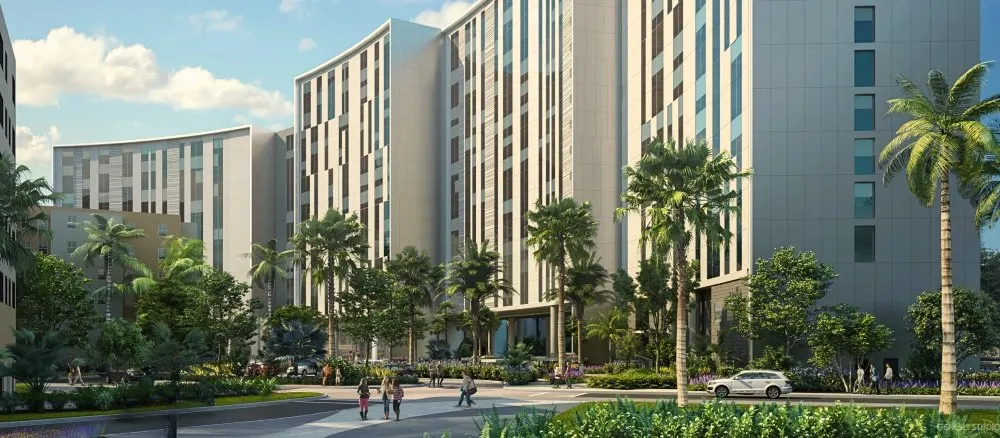
Florida International University's ambitious construction program reflects a broader transformation taking place in Sweetwater, where education, private investment and growing demand for student housing are helping reshape the surrounding real estate landscape.
A university's influence is rarely confined to the boundaries of its campus. Beyond classrooms, laboratories and residence halls, major educational institutions can shape the economic character of entire communities, attracting businesses, creating employment and generating demand for housing, retail and essential services.
Florida International University is increasingly demonstrating that influence in West Miami-Dade.
With a $248 million investment in a new 17 story student residence hall, alongside an expanding portfolio of academic, medical and cultural facilities, FIU is undertaking one of its most ambitious periods of campus development. The projects represent more than an effort to accommodate a growing student population. They reflect a broader institutional vision to strengthen the university's academic standing, expand its research capabilities and establish a more comprehensive campus experience.
For Sweetwater and the surrounding communities, the implications extend well beyond higher education.
A New Landmark for Campus Living
At the center of the expansion is Sunblazer Hall, a planned 17 story residence building that will become the tallest residence hall at an institution within Florida's State University System.
Designed by Stratus in partnership with Moss Construction, the development will provide approximately 1,174 student beds in a distinctive architectural design featuring a curved glass exterior and crescent shaped layout.
The building will include apartment-style residences, studio accommodations, study spaces and a makerspace equipped with technology such as 3D printing. A ground level video wall will also provide space for university events and community engagement.
Expected to open in fall 2028, the project is intended to address persistent demand for on campus housing while creating a more integrated residential environment.
The financial commitment is significant. According to project documents submitted to the Florida Board of Governors, the estimated $248.1 million cost will be supported by university financing and a cash contribution. The investment reflects the increasing cost of developing institutional infrastructure in a market where construction expenses, land constraints and building requirements continue to influence project economics.
Yet the importance of Sunblazer Hall extends beyond its scale and price tag. Student housing has become an increasingly important component of university planning, particularly for institutions seeking to attract students who value proximity, convenience and a stronger connection to campus life.
Building More Than a Residence Hall
Sunblazer Hall is only one part of FIU's broader development program.
The university is also investing in facilities designed to strengthen its position in healthcare, scientific research and cultural programming.
Among the most significant projects is the Helen and Jacob Shaham Academic Medical Center, an eight story facility supported by a $212 million state appropriation and a $30 million philanthropic contribution. Developed in collaboration with Baptist Health South Florida, the center will bring medical education and outpatient healthcare services together under one roof.
The university is also advancing the second phase of its Innovation Complex, expanding laboratory and research space to support scientific development and faculty recruitment.
Meanwhile, the planned CasaCuba cultural and academic center will provide space for the study of Cuban history, heritage and culture, reflecting Miami's distinctive cultural identity and FIU's longstanding connection to the Cuban American community.
Taken together, these investments illustrate a university seeking to expand its influence across multiple disciplines. They also reinforce the relationship between academic institutions and the broader economic infrastructure required to support them.
FIU's stated ambition is to become a Top 30 public university by 2030. Its Experience Impact 2030 strategic plan places considerable emphasis on research, innovation and student success, making the physical expansion of its campus an important part of that objective.
The Emergence of a University District
Perhaps the most interesting real estate implications are developing outside FIU's property boundaries.
As the university expands, private developers are increasingly recognizing the demand generated by its student population. Sweetwater, which directly borders the main campus, is becoming an important market for purpose built student housing.
One planned private development is a 21 story residential building across from campus on Southwest 107th Avenue. The project is expected to provide approximately 820 beds and is scheduled to welcome residents in fall 2028.
Another proposed 29 story development is expected to add approximately 400 residential units.
These projects reflect a growing relationship between universities and private real estate capital. While the university continues to develop and operate its own housing, private developers are responding to demand through residential projects designed specifically for students.
This distinction is important. The expansion of a university can create a relatively consistent source of housing demand, supported by enrollment and the recurring academic calendar. For developers and investors, that can make university adjacent residential properties an attractive alternative to conventional multifamily housing.
However, successful student housing investments still depend on affordability, occupancy, operating costs and the balance between new supply and actual enrollment demand.
The Economic Ripple Effect
The consequences of FIU's expansion may ultimately be felt throughout the surrounding community.
A larger residential population creates demand for restaurants, grocery stores, convenience retail, transportation and personal services. Expanded medical and research facilities can attract healthcare professionals, researchers, faculty and institutional partners. Cultural and academic programming can also bring additional visitors to the area.
These activities can contribute to a more active local economy, creating opportunities for businesses and property owners beyond the university itself.
There is also a broader planning consideration. As institutional campuses expand, the surrounding neighborhoods must evolve to accommodate increased residential density, transportation needs and commercial activity.
For Sweetwater, the challenge will be translating university growth into a cohesive district that serves students, residents and businesses alike.
That means more than constructing additional buildings. Connectivity, public spaces, mobility and the availability of everyday services will help determine whether the area's development becomes a lasting transformation or simply an increase in density.
An Investment in the Future
FIU's expansion offers an interesting example of how educational institutions can function as catalysts for real estate development and economic activity.
The $248 million investment in Sunblazer Hall may be the most visible symbol of this transformation, but its significance is amplified by the medical, research, cultural and privately developed residential projects taking shape around it.
The larger opportunity lies in the ecosystem these investments can create.
As universities compete for students, faculty, research partnerships and institutional recognition, their physical environments become increasingly important. Modern housing, advanced laboratories, healthcare facilities and cultural spaces are no longer secondary considerations. They are part of the infrastructure required to support institutional growth.
For developers and investors, understanding this relationship can reveal opportunities that extend beyond traditional residential and commercial real estate.
Sweetwater's next chapter may be shaped as much by the growth of its university as by the development taking place around it.
And in that respect, FIU's $248 million investment represents something considerably larger than a new residence hall. It is part of a broader effort to build an environment where education, innovation, investment and community development can grow together.
Looking for your next home?
Search luxury condos, waterfront homes and rentals across South Florida.
More news
- Miami's Luxury Evolution and an $817M Construction Loan for Faena Residences · November 2, 2026
- West Palm Beach's Next Big Investment Isn't Just Real Estate. It's Education and Innovation. · October 30, 2026
- Why Canadians Call South Florida Home for the Winter · October 15, 2026