Buyers Across the Country Are Making the Move to Miami
From New York and California to New Jersey and beyond, homebuyers are looking to South Florida for a different kind of life, a new business environment and the opportunity to call one of America's most dynamic cities home.
For decades, Miami has occupied a special place in the American imagination. It has been a destination for winter escapes, a playground for the wealthy and an international gateway connecting the United States with Latin America and the Caribbean. Something has changed in recent years. Increasingly, Miami is no longer simply a place people visit. It is a place they want to live.
From the high rise neighborhoods overlooking Biscayne Bay to the tree lined streets of Coral Gables and the waterfront communities of Miami Beach, buyers from across the country are exploring what a permanent move to South Florida might look like. Some are leaving established careers and familiar surroundings behind. Others are purchasing second homes that may eventually become their primary residences. Many are simply looking for a better balance between professional ambition and personal quality of life.

The movement reflects a broader reassessment of where Americans want to live, work and invest. And Miami, with its distinctive combination of international energy, business opportunity and tropical lifestyle, has emerged as an important part of that conversation.
A Changing Map of American Homeownership
New York has long been one of Miami's most important sources of domestic buyers. The connection is hardly surprising. The two cities share a strong financial and cultural relationship, and their residents have become increasingly familiar with one another through business, tourism and real estate investment.
According to the 2025 MIAMI Realtors international report, New York accounted for 24 percent of out of state buyers in South Florida, making it the leading state of origin for the sixth consecutive year. California followed with 14 percent, while New Jersey represented 9 percent. Together, New York, California and New Jersey accounted for nearly half of all out of state buyers in the region.
These numbers suggest that Miami's appeal extends well beyond its traditional northeastern audience. Buyers from across the country are considering the region as a place to establish roots, diversify their real estate holdings or pursue new opportunities.
The motivations are varied, but the underlying question is often the same with individuals asking themselves "What would life look like somewhere else?"
For some, the answer begins with the climate. For others, it involves taxes, business opportunities, access to international markets or the possibility of enjoying a more flexible lifestyle. Increasingly, it is the combination of these factors that makes Miami compelling.
More Than Sunshine and Beaches
Miami's natural attractions remain an important part of its appeal. Warm weather, ocean access, boating, outdoor dining and an active social environment offer a lifestyle that is difficult to replicate in many major American cities.
Yet reducing Miami's appeal to its climate would overlook one of the most significant developments in the region as its evolution into a major business and professional center.
Over the past several years, the city has attracted increased attention from financial services firms, technology companies, entrepreneurs, investors and professional service businesses. Its international connections, particularly with Latin America, have helped reinforce its position as an important center for global commerce.
For professionals accustomed to operating in major metropolitan markets, Miami offers an opportunity to remain connected to an international business environment while enjoying a different residential experience.
Remote and hybrid work have also changed the equation. Although not every profession offers the freedom to relocate, professionals with greater flexibility can reconsider the relationship between their workplace and their home. For some, the decision is no longer dictated exclusively by proximity to an office.
That flexibility has helped make Miami part of a larger national conversation about lifestyle driven relocation.
The Financial Appeal of Florida
Economics also plays a meaningful role in the decision to relocate.
Florida does not impose an individual state income tax, an important consideration for certain high income households, business owners and professionals moving from states with higher income tax burdens. For buyers evaluating the long term financial implications of a move, the difference can be substantial.
The appeal, however, is not limited to tax considerations. Some buyers are interested in purchasing property in a market with an established international buyer base, while others view Miami real estate as a way to establish a long term presence in a city with significant global visibility.
The region's luxury market has been particularly notable. According to MIAMI Realtors' 2026 South Florida housing outlook, cash transactions represented a substantial share of million dollar and up home sales across several South Florida communities, including Miami, Coral Gables, Miami Beach, Sunny Isles Beach and Golden Beach.
This reflects the presence of financially established purchasers who are often less dependent on mortgage financing and may approach real estate decisions with a longer investment horizon.
Still, the financial calculation requires careful consideration. Florida's insurance costs, property taxes, condominium assessments and association requirements can materially affect the cost of ownership. Buyers moving from other markets are increasingly encouraged to evaluate the complete financial picture rather than focusing exclusively on the state's tax advantages.
Finding the Right Miami Neighborhood
One of Miami's greatest strengths is its variety. The region is not a single residential market, and buyers relocating from other parts of the country often discover that choosing the right neighborhood is just as important as choosing the right property.
For those who appreciate an established residential atmosphere, Coral Gables offers historic architecture, mature landscaping, walkable commercial districts and a strong sense of community. Its Mediterranean inspired homes and distinctive streetscapes provide an alternative to the glass towers that have come to define much of the Miami skyline.
Miami Beach, meanwhile, offers a lifestyle closely connected to the ocean. From historic Art Deco buildings to contemporary waterfront residences, the city appeals to buyers who place a premium on architecture, coastal access and proximity to dining and entertainment.
For those seeking a more urban environment, Brickell has become one of the region's most recognizable residential and financial districts. Its high rise condominiums, restaurants, offices and walkable streets create an atmosphere familiar to buyers arriving from Manhattan, Chicago and other major cities.
Coconut Grove offers a different experience altogether. With its lush greenery, waterfront setting and relaxed residential character, it has attracted buyers who want to remain connected to the city without living in the center of its busiest districts.
These neighborhoods illustrate an important point that moving to Miami does not require adopting a single version of the South Florida lifestyle. Buyers can choose the setting that best reflects their priorities, whether that means an urban condominium, a historic home, a waterfront property or a quieter residential community.
A Market That Is Becoming More Selective
The enthusiasm surrounding Miami should not obscure the realities of the current housing market. The extraordinary migration surge that followed the pandemic has moderated, and affordability has become a more significant consideration.
The University of Florida's Shimberg Center for Housing Studies reported that Miami-Dade County experienced a net domestic migration loss of approximately 72,000 residents in 2025. International migration continued to contribute to the region's population, but it was not enough to offset domestic departures.
Overall, Miami-Dade County had a population count of 2.8M individuals residing within the county limits.
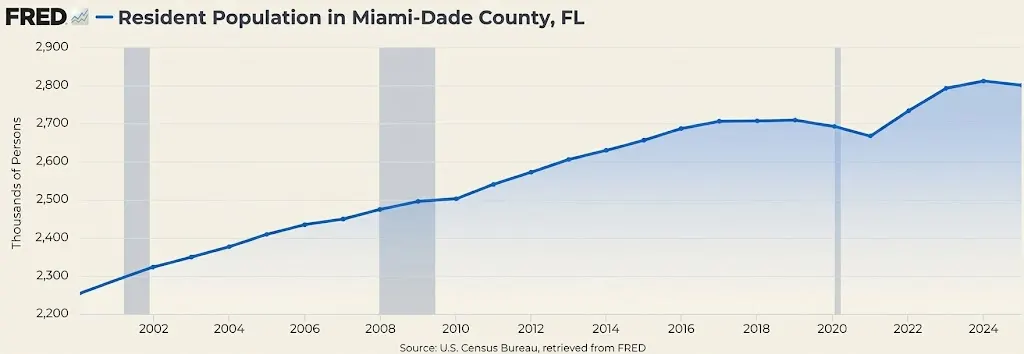
Here's a graph to show the over growth curve of Miami-Dade's population according to the Federal Reserve Bank of St. Louis.
At the same time, Redfin's first-quarter 2026 housing search analysis placed Miami among the leading destinations for relocating home shoppers, with New York remaining its largest source market.
These figures illustrate a more complicated market than the simple narrative of an uninterrupted migration boom. Miami continues to attract substantial interest, but buyers are increasingly weighing housing costs, insurance expenses, financing conditions and the practical realities of everyday life.
For prospective purchasers, that environment creates an incentive to approach the market thoughtfully. Location, property condition, building financial health and long-term ownership costs deserve as much attention as views, amenities and architectural appeal.
It also means that buyers who understand their priorities and take the time to evaluate their options may be better positioned to make informed decisions.
The Next Chapter of Miami
Perhaps the most interesting aspect of Miami's transformation is that it represents more than a change in residential preferences. It reflects an evolving understanding of what a major American city can offer.
Miami has become a meeting point for different cultures, industries, generations and international perspectives. Its identity is constantly being shaped by people arriving with new ideas, professional ambitions and expectations about how they want to live.
For a buyer leaving New York, Miami may represent a chance to exchange winter commutes for mornings near the water. For someone relocating from California, it may offer a new business environment and a different relationship with the East Coast and international markets. For a growing family, it may represent the possibility of a home that accommodates a different stage of life.
Of course, no city is without its challenges. Miami faces questions involving affordability, infrastructure, climate resilience and the long term costs of coastal living. Its continued growth will depend in part on how successfully it addresses these issues.
The city's appeal is unmistakable. Miami is no longer defined solely by tourism or seasonal residents. It has become a serious consideration for Americans deciding where to build their next chapter.
As buyers continue to look beyond the cities and communities they have known for years, Miami is likely to remain an important destination in the national real estate conversation. For many, the decision is ultimately about more than purchasing a home. It is about choosing a lifestyle, embracing new opportunities and finding a place that feels like the beginning of something new.
Looking for your next home?
Search luxury condos, waterfront homes and rentals across South Florida.
More news
- The Intersection of Education, Investment and Urban Development at FIU's $248 Million Expansion · November 3, 2026
- Miami's Luxury Evolution and an $817M Construction Loan for Faena Residences · November 2, 2026
- West Palm Beach's Next Big Investment Isn't Just Real Estate. It's Education and Innovation. · October 30, 2026